

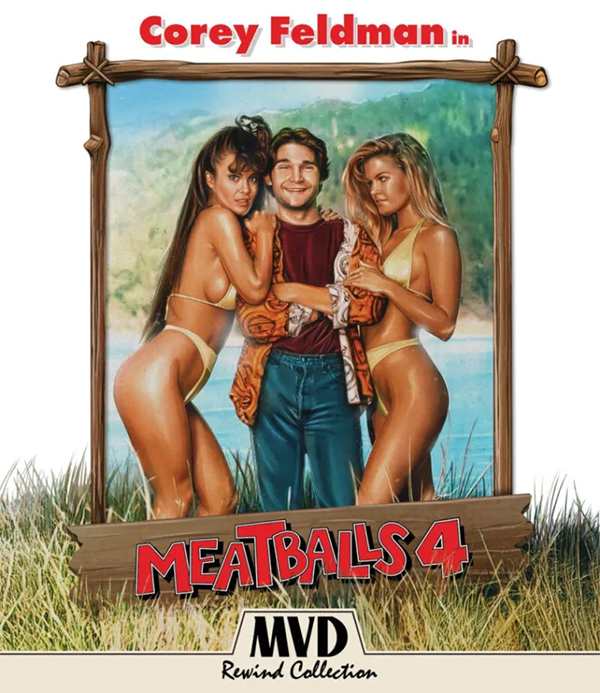
Now available on Blu-ray for the first time—exclusively through MVD, Ronin Flix, and Oldies—is the 1992 comedy Meatballs 4.
What makes this four-film franchise particularly interesting is that, of the three sequels, only Meatballs III: Summer Job was conceived as a true continuation of the original. Meatballs Part II was originally a Canadian summer camp comedy that had the Meatballs title added for its U.S. release. Likewise, Meatballs 4 began life as Happy Campers before being reworked into a sequel mid-production after the producers acquired the Meatballs name—a decision writer/director Bob Logan was unhappy with.
Let’s be honest: there is only one truly great film in this series, and that is the original Meatballs. I enjoyed Meatballs Part II as a kid and watched it many times, while Meatballs III is perhaps most notable for featuring Patrick Dempsey in his first leading film role. For Meatballs 4, Corey Feldman steps into the lead role as he was attempting a comeback following his well-publicized struggles with substance abuse. While Meatballs III at least had a brief theatrical run, Meatballs 4 went straight to video.
The story follows a group of fewer than 30 kids—played by actors who appear to be in their mid-20s—arriving at Lakeside Water Ski Camp with only two weeks left in the summer. The camp is run by Neil Peterson, played by Jack Nance, and is facing severe financial trouble, owing $200,000 that Neil cannot repay. Former employee Ricky Wade (Feldman) leaves the rival camp across the lake, Twin Oaks, to help save Lakeside. Meanwhile, Twin Oaks owner Monica Shavetts, played by Sarah Douglas, wants to buy the struggling camp so she can expand her own resort, but Neil refuses to sell.
One of the unintentionally amusing aspects of Meatballs 4 is its annual water-ski competition, in which the campers seemingly need only two weeks to become expert skiers. There are plenty of plot points that do not hold up under scrutiny, but it is hard to place all the blame on Logan. The producers gave him only two and a half months to write, shoot, edit, and complete the film in time for an upcoming film market. That rushed production schedule helps explain why the story leans so heavily on the familiar “save the camp” formula.
Feldman brings an energetic performance, and frankly, that energy is badly needed. Although Meatballs 4 is short on genuine laughs, it remains a mildly entertaining early-’90s summer camp comedy. It earns its mild R rating mostly through a few topless scenes featuring Playboy Playmates cast as campers. Is it worthy of the Meatballs name? Not really—but none of the sequels truly are. Still, this installment feels even less like a Meatballs movie than the one before it.
The new 1080p transfer offers a noticeable upgrade over the original DVD release. The image is sharper, colors are stronger, and details stand out more—particularly the neon wetsuits and the lush greenery surrounding the lake. The included LPCM 2.0 stereo track also sounds solid and serves the material well.
The most significant improvement with this release, however, is the cover art. I remember renting Meatballs 4 on VHS when it first came out, and the original box art was terrible. The original Meatballs poster was designed by Morgan Kane, Part II by Nick Cardy, and my personal favorite, Part III, by Drew Struzan. Thankfully, MVD enlisted artist David E. Wilkinson to create a new cover inspired by the artwork from the earlier films. He essentially took the original promotional image and gave it an illustrated treatment that finally feels in line with the series. In fact, the new cover feels more like Meatballs than the movie itself.
If you are a fan like me who already owns the first three films in various formats, this release may be worth adding to your collection. I would not mind seeing MVD bring Meatballs Part II and Meatballs III to the MVD Rewind line as well, since I still only own those on VHS.
Bonus Content:
- Interview with Bobby Logan writer/director
- Theatrical Trailer